Vibehours
See how much you vibe code, from the history Claude Code already keeps
- Anyone who uses Claude Code
- 1 October 2026
- The history Claude Code already keeps on your machines
- Days, hours, streaks, tokens and cost, and a picture to share
- Nothing. No sign-in.
- v1.0.0, 1 October 2026. Free and open source (MIT), Windows and Linux.
Vibehours is a small desktop app that shows how much you vibe code. It reads the history Claude Code already keeps, on the PC you sit at or on another box over SSH, and turns it into days, hours, streaks, tokens and cost.
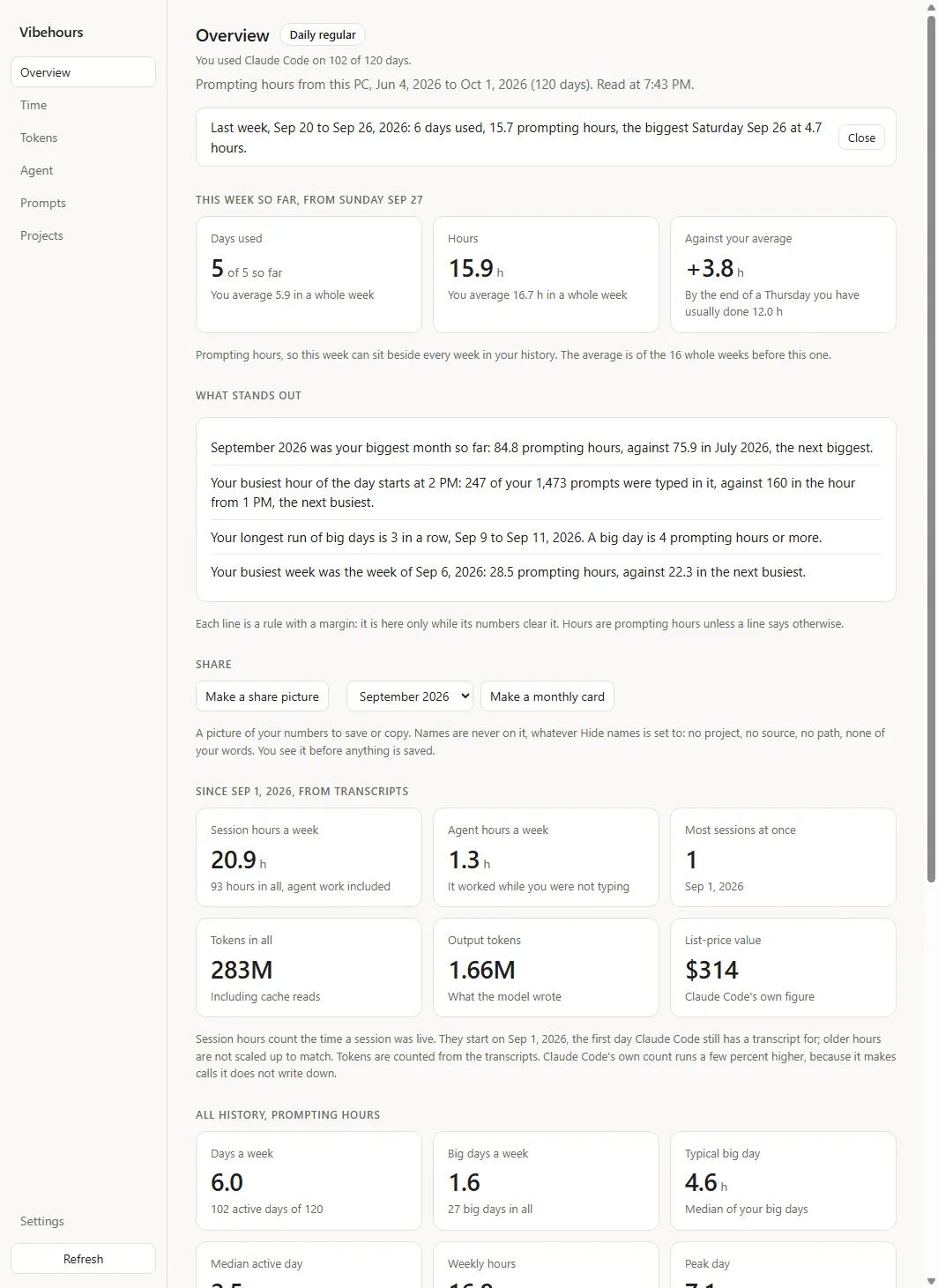
The Overview page, on made-up history.
- Finds it for you. On first run it lists the places Claude Code lives and reads only the ones you tick.
- Counts your time two ways. Prompting hours from your prompt history, and session hours from the transcripts, with the agent’s hours beside yours.
- Says what stands out. Up to four lines, each written by a fixed rule and not by a model.
- Makes a picture to share. A share picture and a monthly card. Project names, paths and your own words are never on them.
- Keeps its own totals, because Claude Code deletes transcripts after 30 days by default.
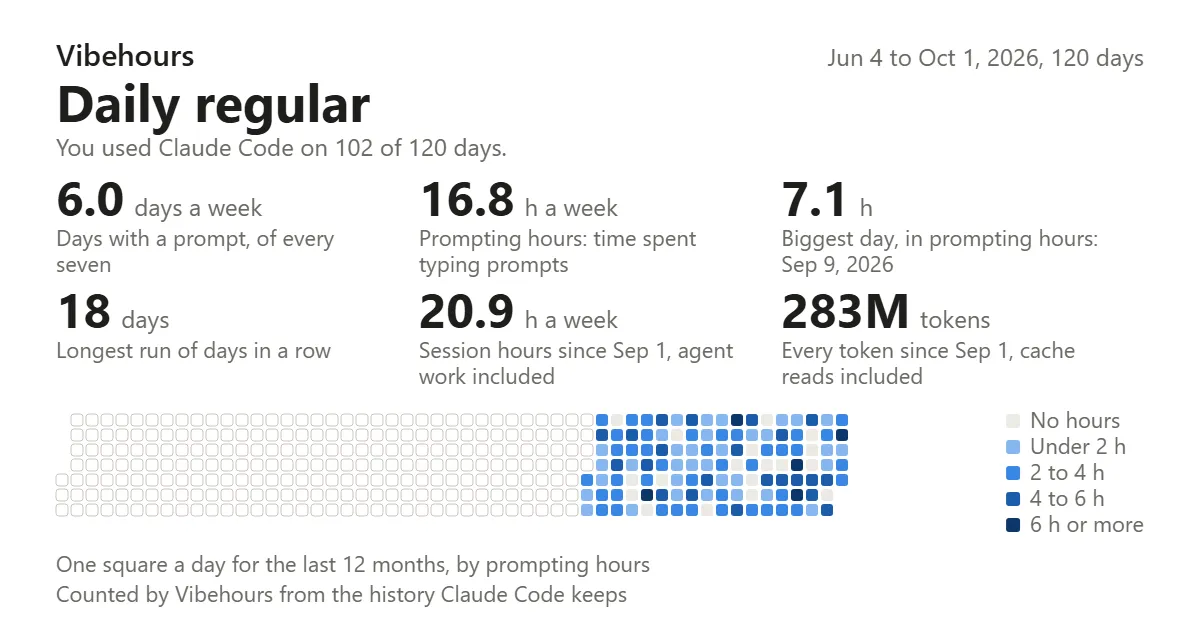
The share picture, from the same made-up history.
No sign-in, and nothing is uploaded. It’s free and open source. Download it for Windows or Linux from the release page. There is no Mac app.
Stack
- Electron
- The desktop window, on Windows and Linux.
- TypeScript
- All of it, compiled with plain tsc. No bundler, no framework and no runtime dependency.
- SVG
- Every chart is drawn by hand. No chart library.
- Canvas
- Draws the share picture and the monthly card.
- SSH
- Reads the history off another box of yours, using the ssh already on your PC.
- GitHub Actions
- Builds the Windows and Linux downloads and takes pictures of the app running on both.
Build log
-
Released v1.0.0, free and open source, for Windows and Linux. Nobody has seen the Linux window yet, and the download page says so.
-
Renamed from Vibestats to Vibehours. The old name was already taken by other tools that do the same job.
-
"Makes no network call" turned out to be false. Electron's spell checker fetched a dictionary on every start. It is off, and the Linux build now fails if the app opens an internet socket.
-
Fixed. A PC with only the Claude desktop app has transcripts but no prompt history, and it now counts as a place Claude Code lives.
-
Installed on my own desktop, it read the sessions there and still said in red that nothing was found. That fix is the next build.
-
Things to say and things to show. Up to four lines on what stands out, written by fixed rules, plus a share picture and a monthly card.
-
Six pages of charts. Each one is hand-drawn, with a sentence under it saying what it shows and a table of the same numbers. One switch hides project names.
-
Tokens and cost, read from the transcripts. Claude Code deletes those after 30 days by default, so the app keeps its own totals.
-
First run. It lists the places Claude Code lives, this PC and your SSH hosts, and reads only the ones you tick.
-
Hours first. It counts prompting hours from Claude Code's own prompt history, a day and a week at a time.
-
Started. Before any code, I answered a round of right/wrong questions about what it should be. It went from a private toy to a free app for anyone.